 中文
中文 A Knitwear Sample Looks Good — But Is It Ready for Bulk Production?
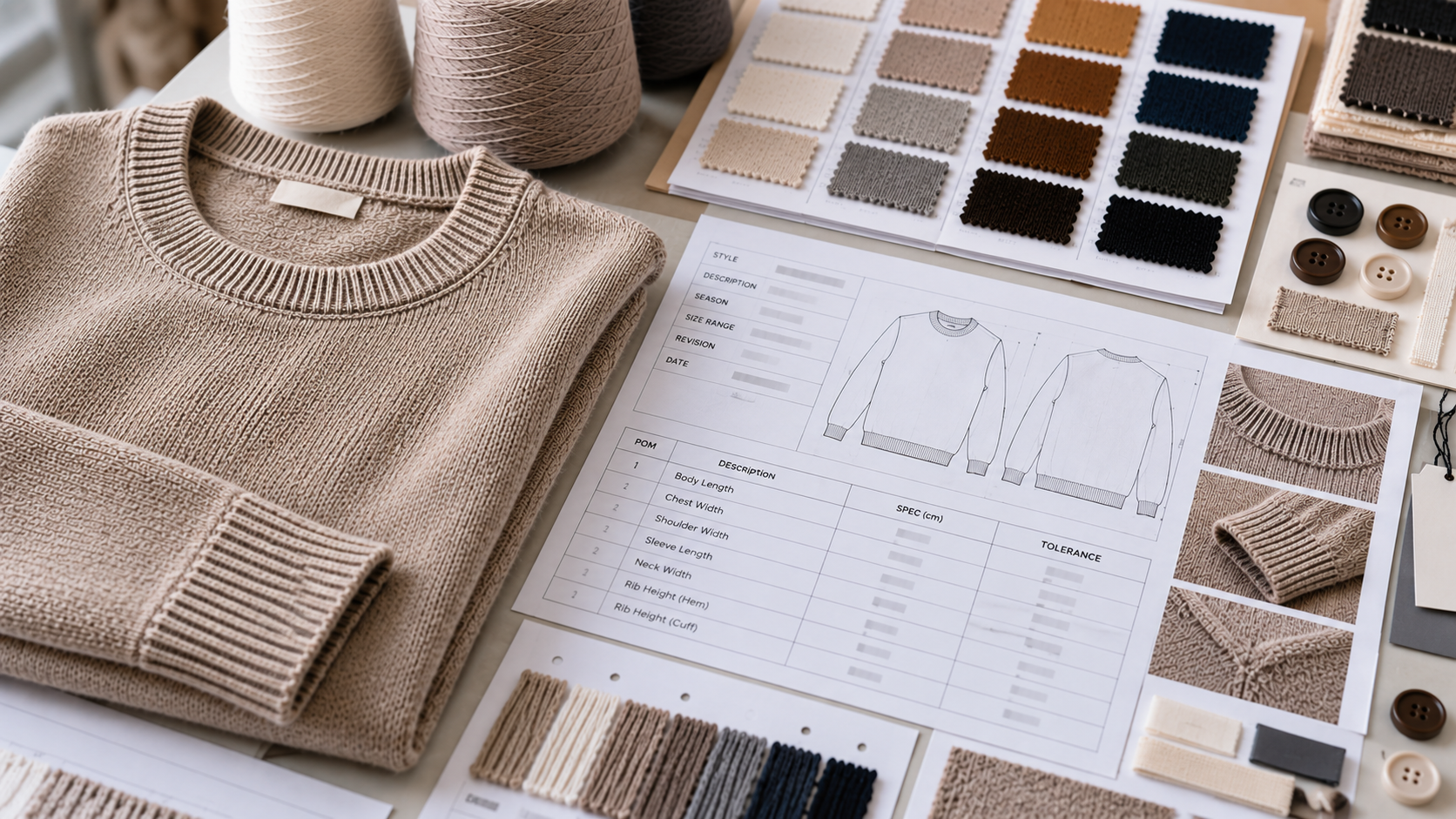
A sweater sample looks good.
The fit has been approved.
The hand feel is right.
The overall appearance matches the design direction.
So, is it ready for bulk production?
Not necessarily.
Imagine this:
The final sample has the correct sleeve length, but the production measurement sheet still shows the previous measurement.
The sample is right.
The document is outdated.
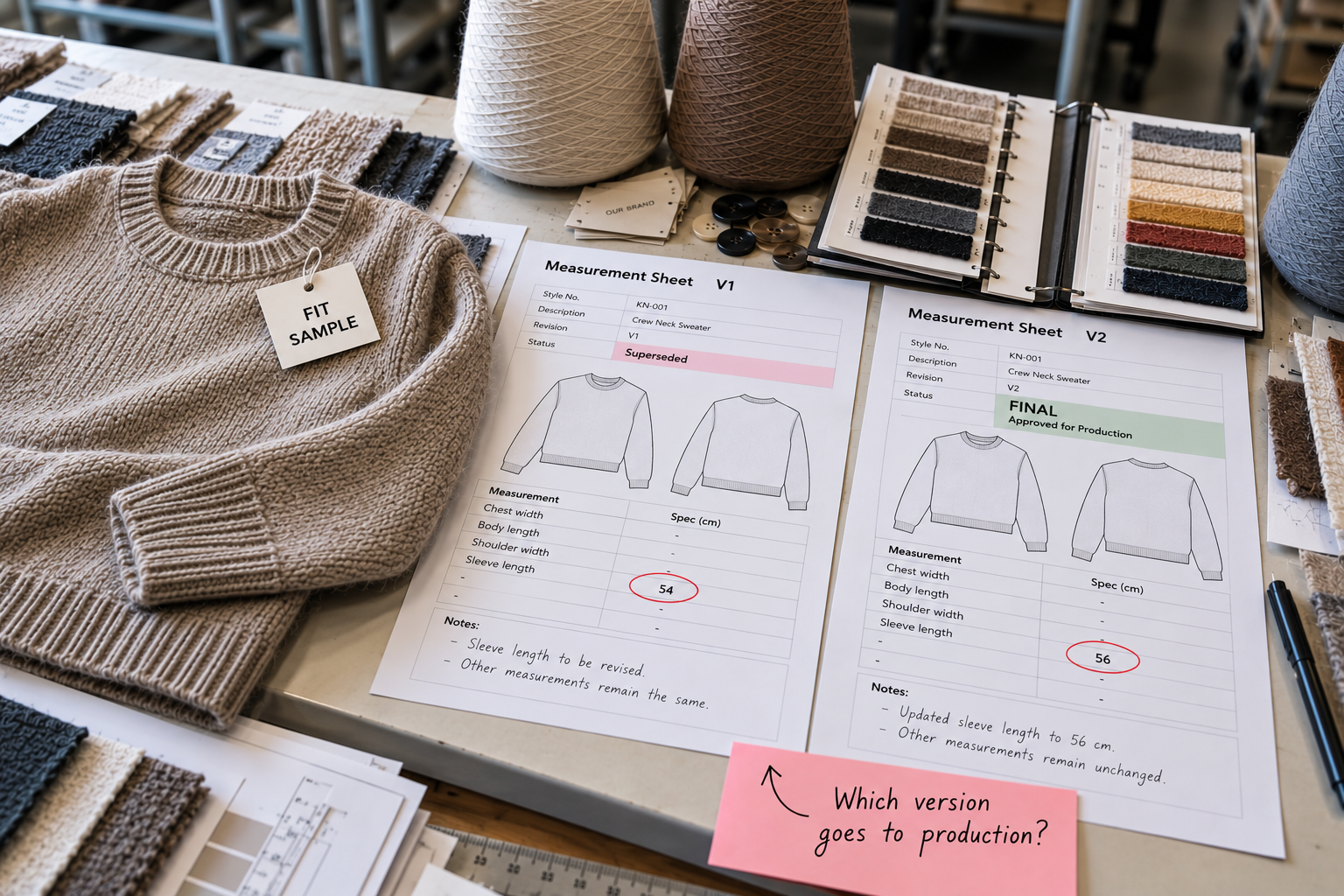
Which version will bulk production follow?
This is why sample approval is not only about whether the garment looks good.
During development, the goal is to test, adjust, and refine the product.
Before bulk production begins, the goal changes:
The approved result needs to become a clear, repeatable production standard.
Before moving into bulk, here are five questions worth answering.
1、What Exactly Has Been Approved?
“Approved” can mean different things.
A brand may say:
“The fit looks good.”
But that does not automatically mean every other detail is final.
The following may still be open:
- Yarn
- Color
- Trims
- Labels
- Finishing
- Packaging
The sample itself should also be clearly identified.
For example:
- Sample stage
- Size
- Color
- Revision
- Approval status
This matters because “final sample” can become ambiguous if nobody has defined what that sample is intended to approve.
One sample may be approved for fit.
Another may confirm color.
A later version may include the final trims or finishing.
Before bulk production, both the brand and manufacturer should know:
Which elements are approved, and which are still pending?
A clear approval scope prevents unfinished development decisions from accidentally becoming production instructions.
2、Are the Final Materials Locked?
A development sample does not always use every final bulk-production material.
During sampling, a temporary trim, available color, or substitute material may sometimes be used to evaluate fit or construction.
That may be acceptable during development.
But before bulk begins, temporary decisions need to be replaced by confirmed production specifications.
The final material information should be clear, including:
- Yarn specification
- Fiber composition
- Yarn color
- Buttons, zippers, or other trims
- Labels
- Accessories
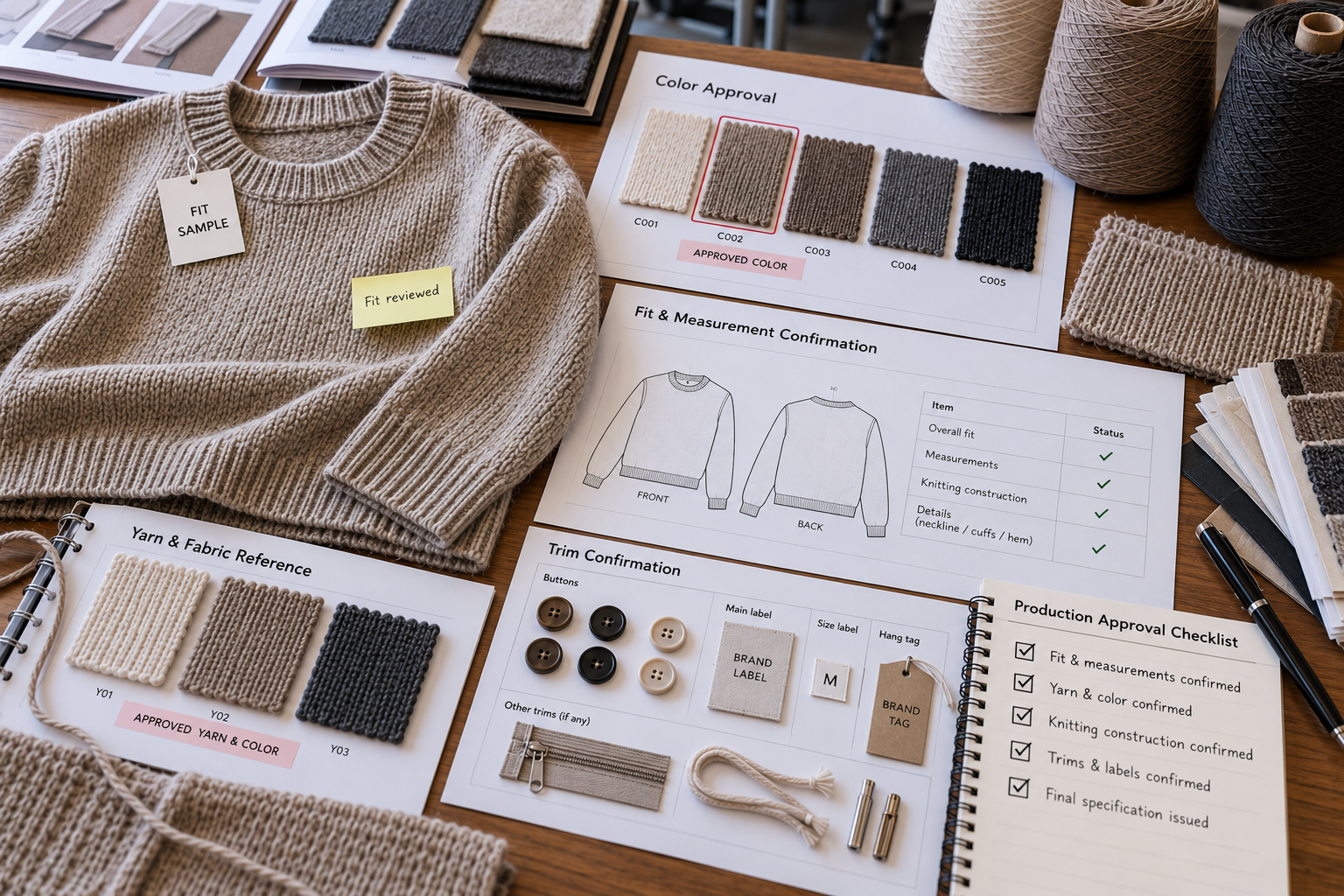
The important question is not simply:
“Does the approved sample look right?”
It is:
“Will bulk production use the same approved materials and specifications?”
A visually approved sample is not a reliable production reference if the materials behind it are still changing.
3、Are the Final Measurements, Tolerances, and Size Range Confirmed?
Measurements often change during development.
The body may be shortened.
The sleeve volume may increase.
The neckline may be adjusted.
The rib depth may change.
Before bulk production, the final approved measurements need to be reflected in the latest production specification.
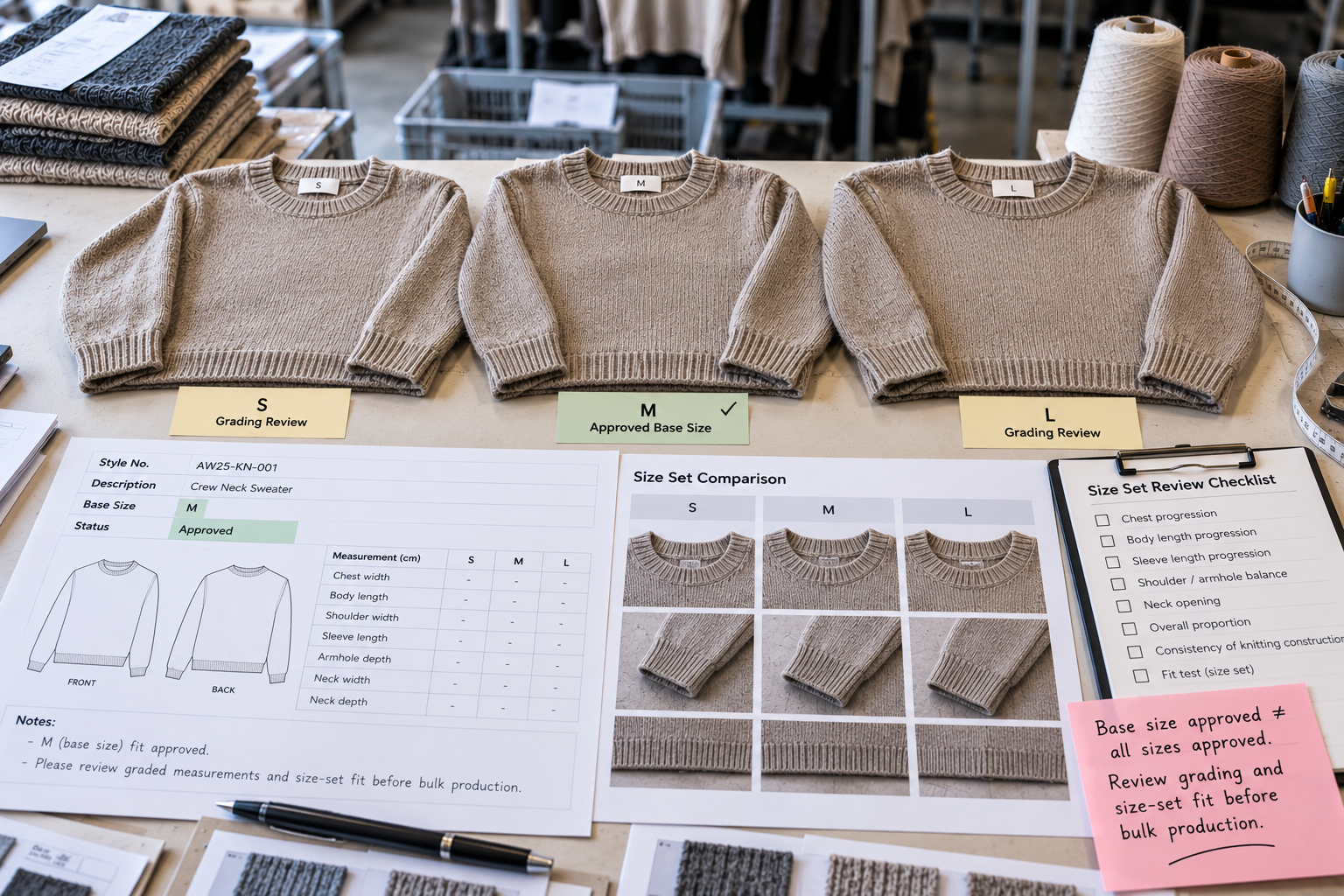
But a measurement chart alone is not always enough.
For each key point of measurement, the production team should understand:
- Where the measurement is taken
- How it is measured
- The target measurement
- The agreed tolerance
For example, simply stating:
Chest width: 50 cm
does not fully define the production standard unless the measuring method and acceptable tolerance are also clear.
What About Multiple Sizes?
Approving one base-size sample does not automatically confirm the entire size range.
If a style will be produced in S, M, L, and XL, the graded measurement chart also needs to be reviewed.
Some proportions do not scale perfectly by simply adding the same amount to every size.
Shoulder position, sleeve volume, neckline dimensions, rib proportions, and trim placement may need additional attention.
Depending on the style, representative size-set samples may also be useful to confirm that the grading works across the intended size range.
This is where version control becomes critical.
A correct final sample with an outdated or incomplete measurement specification is still a production risk.
4、Can the Approved Result Be Translated into a Repeatable Production Standard?
A sample shows that the intended result can be achieved.
Bulk production asks a different question:
Can that approved result be translated into clear instructions and control points that can be repeated consistently?
A development sample may receive close attention from an experienced technician.
But bulk production requires the key characteristics of the approved garment to be controlled across the order.
These may include:
- Key measurements and tolerances
- Stitch structure
- Construction method
- Linking and seam requirements
- Trim placement
- Finishing
- Overall appearance
For example, imagine the approved neckline only looks correct because one technician manually adjusted it during sampling.
If that adjustment is not clearly defined and cannot be controlled consistently during production, the neckline is not yet a stable production standard.
The goal is not to reproduce every tiny feature of one sample by chance.
It is to identify what must remain consistent and make those requirements clear enough for production to follow.
A good sample shows the intended result. A production standard defines what needs to be repeated.
5、Does the Approved Sample Match the Final Production Specification?
By the end of development, there may be:
- Several sample versions
- Multiple measurement sheets
- Email comments
- Revised tech packs
- Updated trim information
- Color approvals
- Finishing comments
If the approved sample reflects the latest changes but the production documents do not, the factory may effectively be working from two different versions of the product.
That creates unnecessary risk.
Before bulk production, the approved sample should align with the final production specification in areas such as:
- Measurements and tolerances
- Grading
- Yarn
- Color
- Construction
- Stitch structure
- Trims
- Labels
- Finishing
- Packaging
The approved sample and the production documents should describe the same product.
There should be one clear approved version, not several partially updated versions.
Before Bulk Production: Six Questions to Answer
| Before Bulk | The Question to Answer |
| Approval scope | What exactly has been approved? |
| Sample identity | Which sample, size, color, and revision is the approved reference? |
| Materials | Are all bulk materials final? |
| Measurements & sizing | Are measurements, tolerances, grading, and size range confirmed? |
| Repeatability | Are the approved construction and appearance translated into clear production standards? |
| Documentation | Do the approved sample and final production files match? |
This is not about adding unnecessary approval steps.
It is about removing ambiguity before production starts.
From Development to Production
Sampling is a development process.
Bulk production is a repeatability process.
The handover between the two is where the product stops being a moving target and becomes a defined production standard.
At that point:
The approved sample is clearly identified.
The materials are confirmed.
The measurements, tolerances, and size range are confirmed.
The construction and finishing requirements are defined.